Validating Your Next Big Idea using AI as a Solopreneur
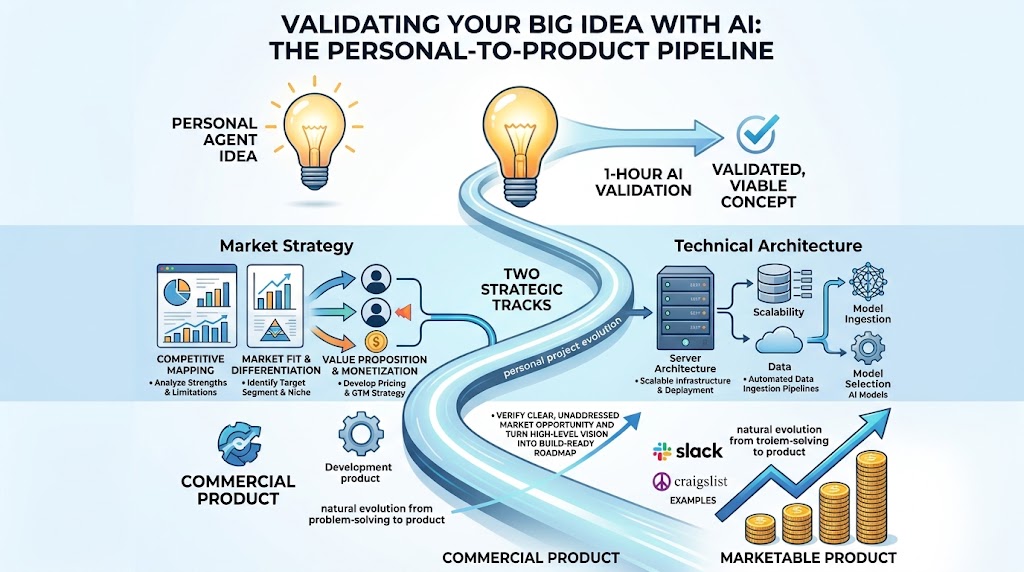
I wanted to use AI to help build and ship a new AI agent idea that I have. While similar products exist, collaborating with AI from the outset showed me exactly how to differentiate my solution to target an underserved market segment—and helped me validate that the concept is genuinely viable before writing a single line of code.
In just a couple of hours, I completed market research and technical validation that would have previously taken months. Coming purely from an engineering background, the business side is uncharted territory for me—but AI is closing the gap. It handed me a clear commercial blueprint, complete with pricing strategy, market positioning, and competitive analysis. Building a product from scratch can feel overwhelming, but treating AI as a thought partner completely transforms planning and technical execution.
I used AI as a thought partner across two main tracks:
1. Strategy & Market Differentiation
Finding the Gap: We mapped out existing tools on the market, analyzing where they fall short and what users are complaining about.
Standing Out: We identified specific features and tweaks that would make my product immediately stand out from competitors rather than just building another copycat.
Monetization: We figured out the best way to price and position the product so it’s actually attractive to real buyers.
2. Product & Technical Design
User Experience: We mapped out the actual screens and workflows to make sure the end-to-end user experience feels smooth and natural.
Data & Logic: We designed the backend flow—figuring out where data comes from, how it’s processed, and how the models talk to each other.
Model Orchestration: We selected the right models for the job and mapped out how to handle prompts, context limits, and backup options if a model fails.
________________________________________________________________________
The biggest takeaway? AI stress-tested and validated the core idea in record time, confirming a clear, unaddressed market opportunity and turning a high-level vision into a build-ready engineering roadmap.
Early on at OpenAI, Sam Altman lightheartedly remarked that their revenue plan was to build superintelligence first and then “ask the AGI to figure out a way to generate a return.” While kicking monetization down the road isn’t ideal for every product, using AI to evaluate market positioning and pricing options early gives you a huge head start on viability.
Now it’s time to build. This project serves as my capstone as I master the stack—because true learning isn’t about acquiring knowledge for its own sake, but instead, we learn best when it’s a natural byproduct of intentionally building a solution for a real market need.
And even if the product doesn’t achieve commercial success, the upside is guaranteed: I’ll have learned a hell of a lot along the way.
The best part about this is that a personal project designed to solve a specific problem can naturally turn into a commercial product. Take Slack, which started as an internal comms tool for a gaming studio, or Craigslist, which began as a simple personal event list. When you build something that delivers real value for yourself, chances are there’s a broader market ready to pay for it, just like I would be willing to pay for it myself.
What makes this shift so radical is that AI is fundamentally redefining what a single operator can accomplish. We’re moving toward an era where running a thriving, scalable business no longer requires a bloated team or massive upfront capital. You just need to learn how to partner with AI effectively so it becomes your co-founder, tech lead, product manager, and growth strategist.
Silicon Valley leaders and venture capitalists are already pointing out that we are on the brink of seeing the world’s first “one-person billion-dollar company.” Watching AI streamline every stage of my own project makes it easy to see how this vision could actually play out. It might not be my specific agent idea that reaches a billion-dollar milestone, but the leverage is real—and the possibility is definitely there. During an interview with Reddit co-founder Alexis Ohanian, OpenAI CEO Sam Altman highlighted this exact shift:
“In my little group chat with my tech CEO friends, there’s this betting pool for the first year that there is a one-person billion-dollar company. Which would have been unimaginable without AI and now will happen.”
While reaching a billion dollars as a solo founder is an extreme outlier, the underlying principle holds: AI compresses the minimum viable team down to one. It handles execution, infrastructure design, and strategy mapping so a single person can focus on product vision and market fit—while AI manages or completely writes the underlying code. While AI can write code autonomously, I’m going to handle the core development myself on this project—using AI assistants like Gemini Code Assist as an intelligent co-pilot to speed up refactoring, debugging, and architecture design.
At the end of the day, you don’t need to know everything—business or technical—to build something great. While I couldn’t figure out all these pieces on my own, an AI-guided learning process bridges the gap: taking you from concept to a build-ready roadmap in hours and enabling you to pull off, as a solo entrepreneur, what previously required an entire company of experts.