US/China AI Rivalry: Don’t Listen to Kai-Fu Lee
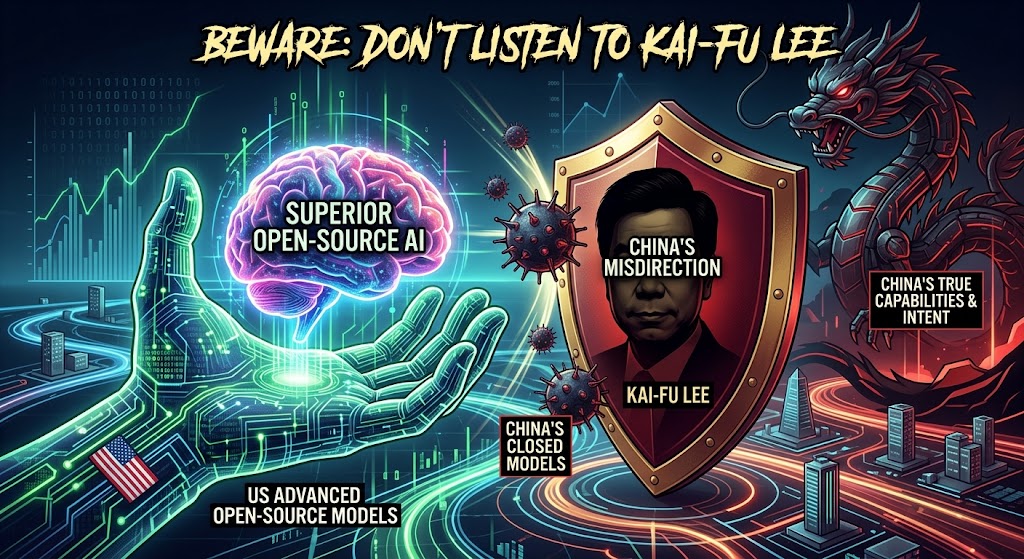
China is trying to emulate what Google did with Android when Google made its mobile operating system open-source. Because of Google’s open-source strategy, they have been able to distribute Android widely, eclipsing Apple’s iOS in market share. But Google was never trying to sell software in the first place; it was just aiming to distribute Android as a platform that Google could use to build an ecosystem to sell its other services–to great effect, I might add.
So China is taking a page out of Google’s playbook by pursuing this open-source AI model approach. After all, Kai-Fu Lee, China’s AI tech darling, is a former Google executive who has outsized influence in China’s tech sector. According to Lee, the competition between China and the US is analogous to what unfolded between Google and Apple’s smartphone duopoly, where both achieved massive commercial success using fundamentally different business models. In his view, we will be like Apple, whereas China will be like Google. He implies that the US shouldn’t worry that China’s models might gain greater market share, because with our advanced closed models, we would still be very profitable, just as Apple has been with its proprietary OS. Certainly, Apple has found success and profitability despite Android, but this might not play out the same way that the Google/Apple rivalry did. And this is problematic for many reasons.
It’s not a given that our closed models will stay profitable like Apple. If global developers, start-ups, and governments build their software infrastructure on top of Chinese open-source/open-weight models, China controls the standards, API integrations, and developer habits worldwide. And unlike smartphone operating systems, controlling the foundational AI stack carries severe national security, defense, and economic infrastructure implications. So Lee’s analogy doesn’t hold.
Kai Fu Lee is doing what China always does when it’s in the weaker position–hiding their true capabilities and intentions while biding time. Don’t be fooled by Kai Fu Lee’s attempt to lull us into complacency with false reassurances. We can’t accept Lee’s premise that it’s an inevitability that China’s cheap AI models will outmaneuver us with greater reach. We’ve got to beat them at this game and develop superior, cost-effective open-source models that can capture global market share. This also means we need to have our technology proliferate not just in the developed world, but in developing countries, even though there isn’t as much money to be made.
Perhaps Nvidia has read the tea leaves since they seem to be investing heavily in open-source, open-weight AI models, but much more needs to be done, and it needs to be done with urgency. Maybe there needs to be a national effort like the Manhattan Project, with an all-hands-on-deck, top-secret collaboration between government and industry to achieve strategic supremacy because the market doesn’t always get it right, especially with China’s structural distortions. China is already ahead in this regard, moving quickly to claim global dominance in open-source AI, so the time to catch up is now.
The stakes are high, and our future economic and national security depends on it.